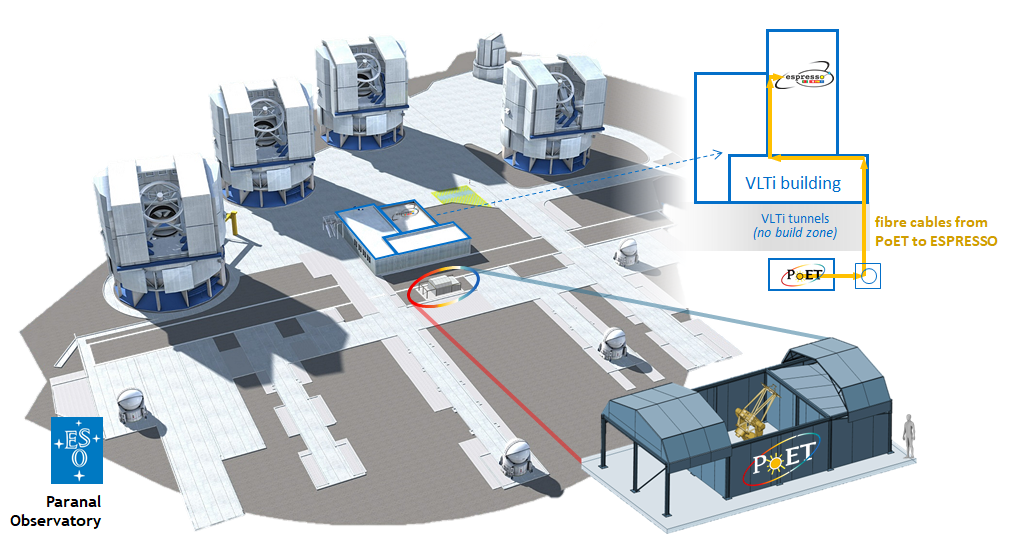
To capture and study the light emitted by the Sun, PoET includes the design of a dedicated solar telescope to interface with the ESPRESSO (Echelle SPectrograph for Rocky Exoplanets and Stable Spectroscopic Observations) spectrograph, installed in the VLT Observatory, ESO (Chile). Funded by the European Union ERC FIERCE project (FInding Exo-eaRths: tackling the ChallengEs of stellar activity, 101052347) lead by IA, PoET started operations in April 2026.
PoET’s design features a two-telescope system, a main telescope with a pointing telescope attached to it. The pointing telescope is a solar feed, integrating the light from the full disk of the Sun. The main telescope is used to spatially resolve with higher resolution a smaller area on the solar disk. With this configuration we expect that spectra of small sections at the Sun’s surface will be obtained with different selected spatial resolutions, ranging from 1 to 55 arcseconds. This configuration allows us to obtain, simultaneously, disk integrated (“sun-as-a-star”) and disk resolved observations.
Spectra of the Sun as acquired by PoET can be obtained in ESPRESSO's High Resolution and Ultra-High Resolution modes (R~140000 and 220000, respectively), and simultaneously covering the wavelength range from 380 to 780 nm in one single shot.
SYSTEM CONFIGURATION
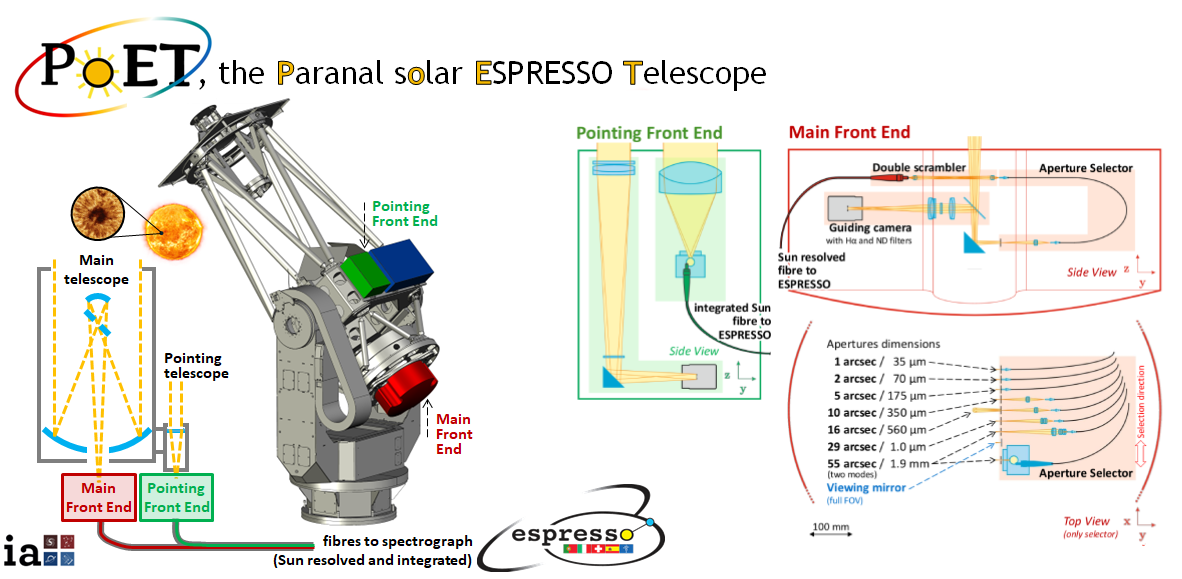
The pointing telescope is piggy-backed into the main telescope’s structure. It is composed by two sub-telescopes – the science telescope (equipped with a ∅75 𝑚𝑚, 𝑓 = 100 𝑚𝑚 lens) and the imaging telescope (with a ∅50 𝑚𝑚, 𝑓 = 350 𝑚𝑚 lens). A guiding camera is installed in the imaging arm – it is used to ensure the solar disk is properly centered before light is collected and injected into a Ø10 mm integrating sphere in the science arm and sent towards the spectrograph. In the same piggy-back structure, a SHABAR is installed, to monitor seeing conditions.
The main telescope has a Gregorian configuration, with a ∅600 𝑚𝑚 primary mirror. Built by Officina Stellare, the telescope has an heat rejector at the intermediate focus of the ∅200 𝑚𝑚 secondary mirror, reducing power while keeping image quality, to safely deliver sunlight into PoET’s main frontend.
At the front-end of the main telescope, most of the sunlight (95%) is focused on a pinhole, effectively cropping transmitted light to the desired aperture size. The remainder light is reflected from the polished pinhole surface and redirected to the guiding arm with a beamsplitter. A camera is used to check in real time what the telescope is seeing, to ensure the correct target will be observed. The pinhole dimensions can be selected using an aperture selector; the available aperture dimensions are [1, 2, 5,10, 16, 29, 55, 55IS] arcsecond. With the exception of option 55_IS (which focuses the light into an Ø10 mm integrating sphere), light from all other apertures – either directly or via lenses – is focused and injected into a small fibre. Using a lens doublet, light from the selected small fibre is injected into the long fibre and sent to ESPRESSO.
LOCATION @ ESO’S VLT PLATFORM